From Falling Off Buildings to Flying Above Them
A normal workday once meant being set on fire, sprinting out the back door of a nightclub, and getting shot down a staircase, all while disguised as a vampire. That was my life as a stunt performer on shows like The Strain. From the outside, it looks thrilling and glamorous—explosions, impossible jumps, and high-speed car chases—but behind the scenes, stunt work is serious business built on precision, trust, and preparation.
Movie magic hides a lot of reality. For example, those car chases that look like they’re tearing through a city at 100 miles per hour are usually happening closer to 35 mph, so the camera car can move through smoothly and capture those epic shots. What looks reckless on screen is actually carefully controlled. Every movement is planned, rehearsed, and coordinated with a team whose job is to make danger look real without anyone getting hurt.
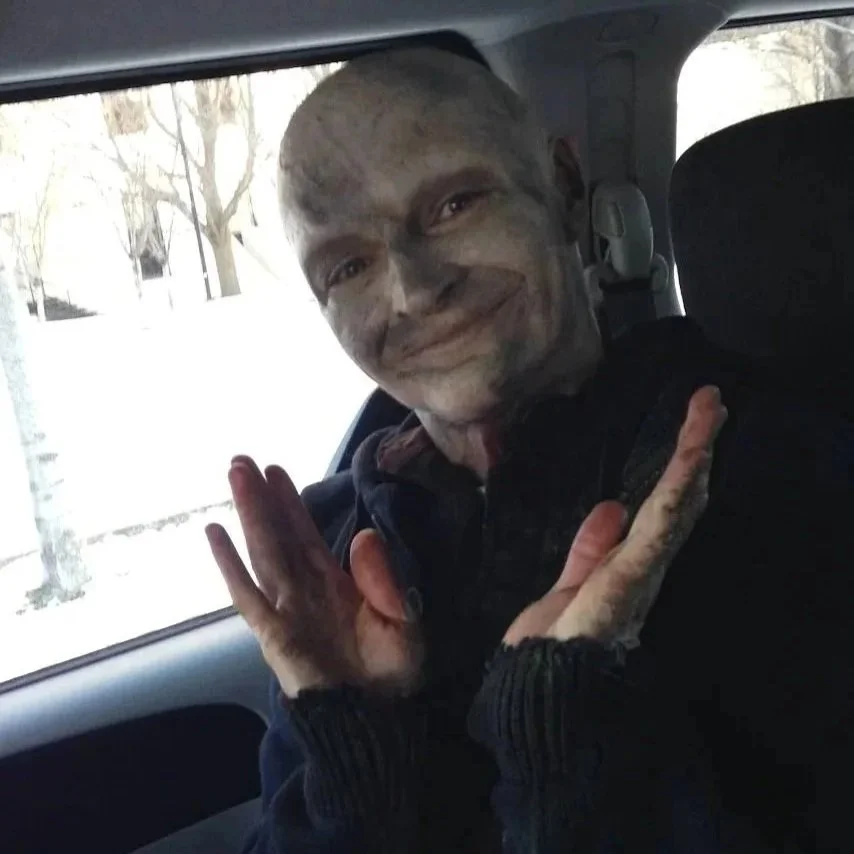
The Strain
In transport to perform a partial fire burn on Guillermo del Toro’s The Strain.
What I carried away from that world wasn’t the adrenaline but the lessons people passed down to me. Stunts are rarely about one person being fearless; they’re about people trusting each other and helping someone push past their own hesitation. I remember avoiding driving stunts entirely when I first started. Precision driving under pressure was something I had no interest in volunteering for, and I found ways to quietly stay out of it whenever possible. Eventually, someone I trusted pulled me aside, shared a few simple tips, and believed in me a little more than I believed in myself. That vote of confidence mattered more than the stunt itself. It showed me that sometimes the biggest barrier isn’t the task in front of you but the voice in your own head telling you not to try.
Years later, I ran into the same feeling again, but this time it was in an airplane. Learning to fly started simply enough. Straight-and-level flight felt manageable, and the early lessons were exciting. But spin training changed everything. Feeling the G-forces and watching the world rotate outside the cockpit window gave me a deep respect for what an airplane can do when it’s not in a comfortable, controlled state. It was humbling in the best possible way. Instead of pushing through it immediately, I stepped back for a while. Part of that decision was financial—aviation training is expensive—but part of it was also realizing that this skill demanded more experience and discipline than I had at the time. Walking away wasn’t defeat; it was respect.
Life has a funny way of circling back, though, when you’re ready. After moving to the United States (Los Angeles, California), I found myself in one of those intense periods where everything was happening all at once. I was getting married, navigating immigration paperwork, building work opportunities, and somehow returning to aviation training all in the same year. My husband kept telling me something simple but powerful: that just like our marriage, when you commit to something, magic can happen. With that encouragement, I approached flying the same way I had approached stunts years earlier—by diving in and surrounding myself with people who knew more than I did. Every instructor, pilot, mechanic, and mentor adds another layer of knowledge. Aviation, like stunt work, turns out to be deeply collaborative.
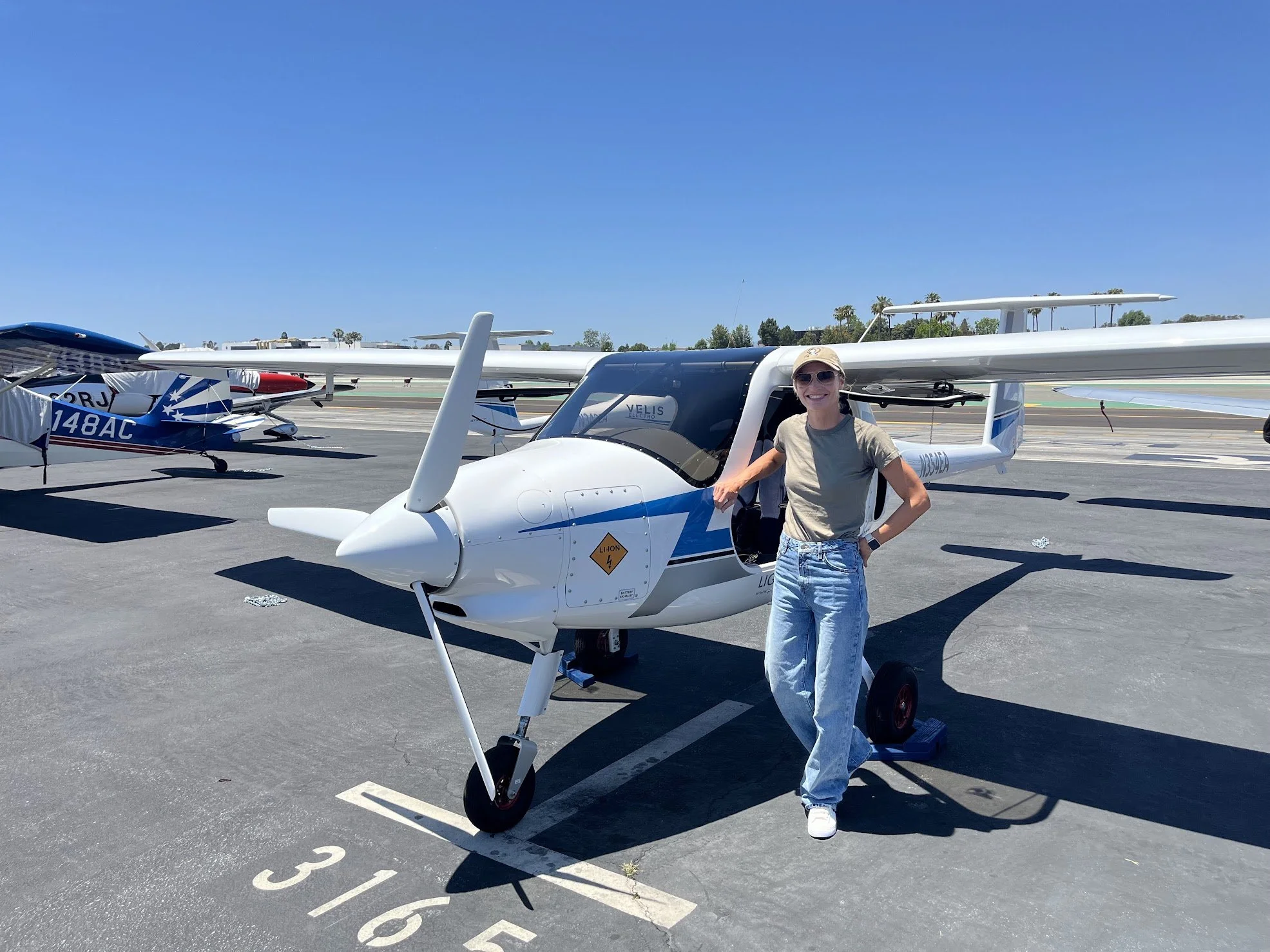
The Velis Electro at KSMO reignited my passion for aviation and brought me back to myself.
That sense of community is one of the things that surprised me most. The film industry can feel mysterious and difficult to access. Producers chase funding that may never materialize. Actors (even crew members) compete fiercely for the same roles. There are invisible walls between union and non-union work, between departments, between people trying to climb the same ladder. Aviation, by contrast, is hungry for people. Yes, it’s expensive—there’s no denying that—and the only bleeding you’ll definitely experience is from your wallet. But where there’s a will, there are usually multiple paths in. Scholarships exist, mentors appear, and people genuinely want newcomers to succeed because the industry needs the next generation of pilots, engineers, instructors, and technicians.
The opportunities are broader than most people expect. You can fly, teach, maintain aircraft, design systems, or do what I’m doing, contributing through writing, training, and emerging technologies like simulation and virtual reality. For someone with a background in storytelling and film, aviation has opened doors I never anticipated. I’ve been able to write about it, explore new training tools, and even work with technology that blends immersive storytelling with real-world skill development. It’s a field that rewards curiosity and persistence.
That doesn’t mean film doesn’t have its own value. Working on sets taught me how complex collaboration really works. You see a miniature version of society on a film production: producers, directors, actors, union crews, assistants, and extras all contributing to the same project from very different positions in the hierarchy. Everyone matters, but the structure can feel rigid and sometimes out of balance. As the industry now wrestles with the rise of AI and new distribution platforms, that hierarchy may begin to shift. Filmmakers today can shoot projects independently, edit them on laptops, and release them online without waiting for traditional gatekeepers. In that sense, the runway for creativity is expanding.
The biggest lesson I carried from both worlds is that progress almost always requires some investment—of time, money, energy, and humility. Whether someone is trying to enter aviation or film, the advice ends up sounding similar: invest in your training, build a portfolio or demo reel, keep learning constantly, network with people who inspire you, find mentors who will challenge you, and help lift others along the way. The industries may look different on the surface, but growth inside them follows the same principles.
I may not be throwing myself off buildings anymore, but I still jump into projects where storytelling meets technology and training. The difference is that today the excitement doesn’t come from pretending to survive danger on a movie set. It comes from discovering new ways to learn, build, and explore a field that keeps opening doors in unexpected directions.
Most importantly, I learned that the feeling I had standing at the edge of a four-story building, ready to perform a stunt and wondering if I could really do it, still creeps up in the cockpit before a lesson, knowing the next challenge will push my skills a little further than the last one. The stakes are different, and the scenery has changed, but the lesson is the same: the most interesting things in life usually begin just beyond the point where you feel comfortable enough to try.
The Commander — a camera rig vehicle used to film driving and chase scenes forThe Indian Detective with Russell Peters.